Success · 31 August 2026
The general track (VG) and its levels 1 and 2: the complete parents’ guide
Level 1, level 2: many Vaud parents get the higher one wrong, and do not know levels can change twice a year, at precise thresholds. This guide details the real mechanics: required averages, promotion thresholds, bridges to the VP and the raccordement, with official figures.
 By The SOS teaching team14 min readReviewed by the teaching team
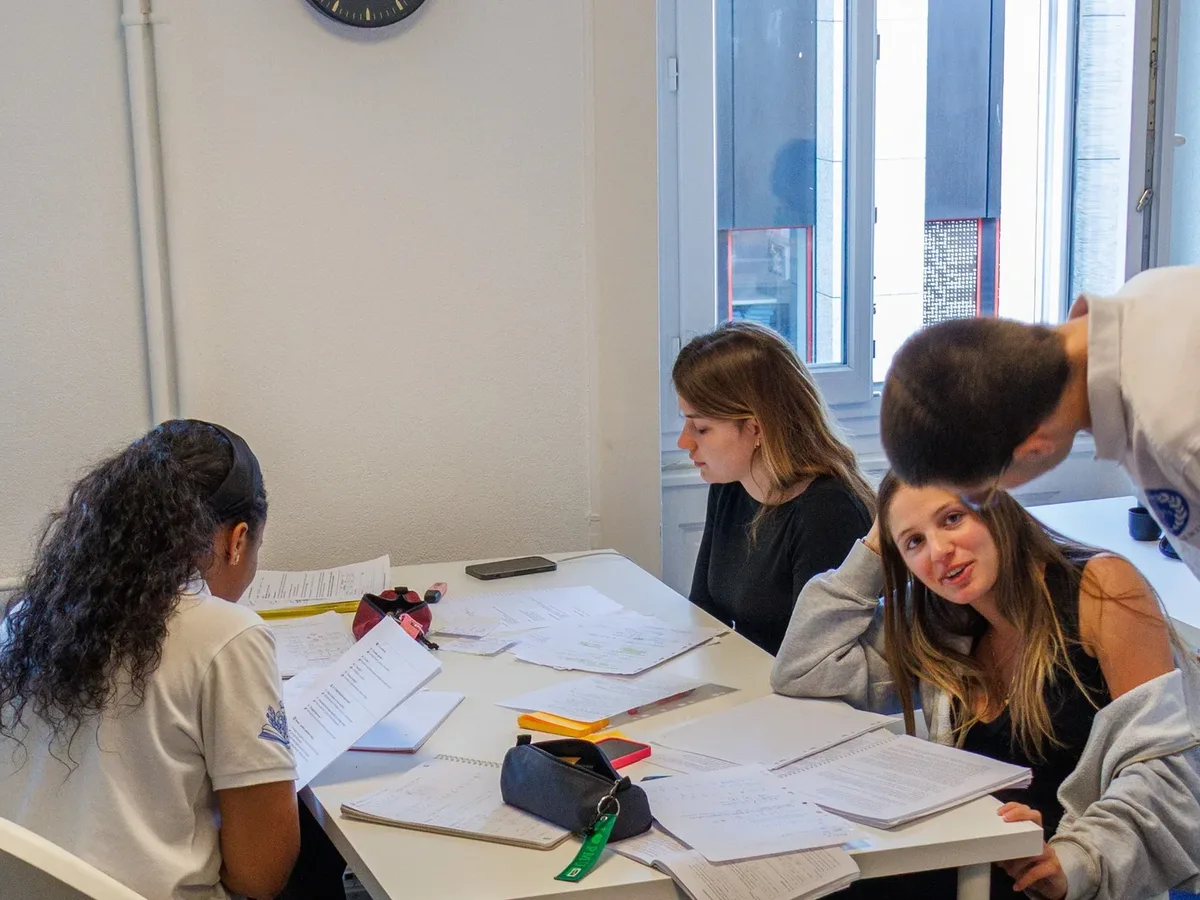
Level 1 or level 2: three subjects, two change windows a year, and thresholds decided by half a mark. · Photo : Soutien-Omni-Scolaire
From the end-of-Year-8 orientation, parents whose child enters the general track (VG) discover a confusing vocabulary: level 1, level 2. And the first question is almost always asked back to front: 'level 1 is the best one, right?'
No. And this mistake matters: it leads families to relax when they should act, or to worry for no reason. This guide sets the record straight, then goes much further: the exact averages to change level, promotion thresholds, the two routes to join the pre-gymnasium track, and the raccordement, that extra year few parents know about, which can reopen the door to gymnasium.
The essentials
- 1Level 2 is the higher one: level 1 = basic requirements, level 2 = higher requirements.
- 2Levels exist only in French, mathematics and German, and are decided subject by subject.
- 3Levels can change twice a year: moving from level 1 to level 2 requires an average of 5.5 (or 5 on the teacher’s recommendation).
- 4Joining the VP from the VG is possible but demanding: level 2 in all three subjects and 50.5 points in the main group, without repeating a year.
- 5The raccordement (Rac 1 and Rac 2) offers an extra year; Rac 2 grants the pre-gymnasium certificate and reopens access to gymnasium.
What the general track is, and where it leads
The VG is one of the two lower-secondary tracks (Years 9, 10 and 11), alongside the pre-gymnasium track. Officially it leads to apprenticeship, the general-culture school, the commerce school and the vocational-maturity orientations.
It must be said plainly, because many families take it badly: the VG is not a track of relegation. It is the route a large share of Vaud pupils take toward demanding qualifications and trades that are hiring. Once orientation is settled, the real question is no longer "VG or VP" but "how to get the best out of the VG", and that starts with understanding the levels.
Levels 1 and 2: the mistake to clear up
Here is the point half of parents get backwards. In official terms, "level 1 corresponds to basic requirements, while level 2 corresponds to higher requirements". Level 2 is therefore the higher one.
These levels exist in three subjects only: French, mathematics and German. Every other subject is taken in the same way by all VG pupils. So the distinction plays out on those three alone, and that is good news: the ground to cover is narrow, therefore readable.
A second idea to correct: a pupil is not "in level 1" or "in level 2" as a block. Levels are decided subject by subject. A child may perfectly well take mathematics and German at level 2 and French at level 1. The profile is fine-grained, and it changes.
How levels change: the exact thresholds
This is the most useful information in this article, and the most rarely given. Levels are not fixed for three years: they can be reviewed, and there are two windows each school year, mid-year and year-end.
Moving up from level 1 to level 2
Moving from level 1 to level 2 requires an average of 5.5 or more in the subject concerned. It remains possible with an average of 5, on the teacher’s recommendation. This threshold applies both to the mid-year change and to the year-end one.
Above all, remember this: the teacher’s recommendation opens a real margin. A pupil steadily at 5.0, serious and improving, is not in the same position as one who reached 5.0 erratically. Work attitude counts, and it is built from September.
Moving back down from level 2 to level 1
In the other direction, the move from level 2 to level 1 happens at year-end with an average of 3 or less, or 3.5 on the teacher’s recommendation. It can also be made at the parents’ request, or on recommendation.
This deserves a warning. Moving down relieves pressure in the short term, but closes doors downstream, as we will see with the raccordement. Before requesting a change to ease the load, it is worth examining whether targeted support would allow the pupil to hold level 2.
A worked example
Take a Year 9 pupil, at level 1 in mathematics. She ends her first semester with a decimal average of 5.2, which the canton rounds to the nearest half-point: 5 on the report. That is a good result, but it is not automatically enough: the threshold is 5.5, and the move at 5 depends on the teacher’s recommendation, which she has a good chance of getting if her work is steady.
Yet she was very close: at a decimal average of 5.25, rounding would have taken her to 5.5, and the move would have been settled without depending on anyone. Five hundredths therefore separate an "it depends" from a settled situation. On a single subject, that is one better-prepared test, or one concept revised in time. It is exactly the kind of gap targeted support can close, whereas work spread across ten subjects would not.
“On levels as on orientation, the difference is almost never decided in whole points: it is decided in tenths, on one or two subjects.”
The SOS teaching team
Promotion in the VG: do not confuse it with levels
Another distinction many parents discover late: level and promotion are two different things. The level says which syllabus the pupil works to; promotion says whether they move up a year.
In the general track, in Years 9 and 10, promotion requires 44 points or more in the main group, covering all subjects, and 16 points or more in the restricted group, that is French, mathematics and German. A pupil can therefore be promoted while staying at level 1, and conversely struggle with promotion despite a level 2 in one subject.
Joining the pre-gymnasium track from the VG: two routes
This is the question many families ask after orientation. The official answer is yes, but the conditions are precise, and they differ depending on whether repeating a year is accepted.
Without repeating, in Year 9
The move to VP without repeating concerns Year 9. It requires level 2 in all three levelled subjects, plus a specific option, with 50.5 points or more in the main group and 19 points or more in the restricted group.
These thresholds are deliberately high: they match a pupil who is in fact already working at VP pace. It is a real route, but reserved for solid records.
With repeating, in Year 9 or 10
The other route, accepting to redo a year, also requires level 2 in all three subjects, but with lower thresholds: 46.5 points or more in the main group and 15 points or more in the restricted group, the same requirements as the initial end-of-Year-8 orientation.
In both cases one constant stands out: level 2 in all three subjects is the entry condition. That is why everything said above about level changes is not an administrative detail, but the key to the whole file.
The raccordement: the door few parents know about
The raccordement is an extra year, after the general-track certificate, allowing a pupil to reach results out of reach until then. There are two forms, often confused, and the difference is considerable.
Rac 1
Rac 1 allows a pupil to reach the results giving access to the general-culture school, the commerce school or the vocational-maturity orientations. Admission works on a sliding scale, calculated on the combined total of French, mathematics and German, and depending on the levels followed.
- All three subjects at level 2: 12 points or more.
- Two subjects at level 2, one at level 1: 13 points or more.
- One subject at level 2, two at level 1: 14 points or more.
- All three subjects at level 1: 15 points or more.
- A tolerance of half a point below the threshold is allowed.
The logic is clear, and it is worth explaining to pupils: the more subjects taken at level 2, the fewer points needed to enter the raccordement. Each level 2 gained lowers the requirement by a full point. On leaving Rac 1, access to the target pathways requires a total of 13.5 points or more in French, mathematics and German.
Rac 2, the real second chance
Rac 2 is of another nature: it allows a pupil to obtain the pre-gymnasium certificate. In other words, a pupil who went through the VG can, via this extra year, earn the same certificate as a VP pupil, and then access all post-compulsory pathways, from gymnasium to apprenticeship.
Its admission conditions are demanding and consistent with that stake: all three subjects followed at level 2, 46.5 points or more in the main group and 15 points or more in the restricted group, with a tolerance of half a point per group.
This is the most important information in this article for a family that aimed for the VP and did not get it: the gymnasium door is not permanently closed at the end of Year 8. It remains reachable, provided level 2 in all three subjects has been held or regained.
What this means in practice
Putting all these figures together, a simple strategy emerges, and it fits in one sentence: level 2 in all three subjects is the key that opens almost every door downstream.
- It conditions both routes into the VP.
- It is required for Rac 2, therefore for the pre-gymnasium certificate.
- It lowers the Rac 1 entry threshold from 15 to 12 points.
Useful effort is therefore concentrated, not spread: French, mathematics, German. And it is early, because the level-change windows fall mid-year and year-end: work started in September has two chances to pay off within the year; work started in April has barely one.
The mock exam, to measure the gap to level 2
Since the move to level 2 is decided at 5.5, or 5 on recommendation, the useful question is not 'is he good at maths?' but 'how many tenths is he from the threshold, and on which concepts?'. An impression cannot answer that; a measurement can.
That is what the mock exam provides, one of the strengths of our support: a test under real conditions, at the expected format and level, corrected then analysed to place the pupil precisely against level 2 requirements in each subject. It reveals what is missing before the teacher records it in the report.
Repeated before each level-change window, mid-year and year-end, it lets the pupil arrive at the right moment with a solid record rather than with hope.
How we support VG pupils
Our approach follows directly from the above. We target the three levelled subjects, pinpoint exactly where the pupil loses the tenths separating them from the threshold, and work on those points over time rather than in a rush before assessments.
We also give weight to consistency and method, because the teacher’s recommendation, which can tip a level change at 5.0, is earned through steadiness and work attitude, not an isolated peak. In our centres in Lausanne, Vevey and Montreux, and at home across the canton, this is the framework we put in place.
And to stay honest: no support guarantees a level change or an admission. What can be worked on is the margin. On thresholds decided by half a mark, the margin often makes the difference.
Note: thresholds and procedures may change, and their application rests with the school. The figures cited here come from the canton’s official documents; for your child’s exact situation, the reference remains their school management.
| Decision | Numerical condition |
|---|---|
| Moving from level 1 to level 2 | Average of 5.5 — or 5 on the teacher’s recommendation |
| Dropping from level 2 to level 1 | Average of 3 or below — 3.5 on recommendation |
| Being promoted within the voie générale | 44 points (main group) and 16 points (restricted group) |
| Moving to VP without repeating | Level 2 in all three subjects, specific option, 50.5 and 19 points |
| Moving to VP by repeating | 46.5 and 15 points |
| Entering the ECG from VG | 13.5 points (three level 2s) or 14.5 points (two level 2s) |
Going further
- Calculate your child's orientation and promotion
- Rac 1 and Rac 2 bridging classes: conditions and points
- By the 10th year, four of five chances to change level have passed
- Entering the 9th year: levels and the January report
- Every point threshold, from the 6th year to gymnasium
- Our mock exams under real conditions
- The pre-gymnasium track (VP): the complete guide
- VP or VG: understanding orientation in 8P
- The ECR: the 30% weight in 8P
- Individual lessons
Our centres
A teacher near you
- Tutoring in VeveyPassage Saint-Antoine 7, 1800 VeveyRight next to Vevey station (trains and regional buses)See the centre
- Tutoring in LausanneRue Saint-Martin 9, 1003 Lausanne2 minutes from the Bessières metro stopSee the centre
- Tutoring in MontreuxAvenue des Alpes 27B, 1820 MontreuxA few minutes’ walk from Montreux stationSee the centre
What actually changes
A specialist for each subject
Not a generalist covering everything: a teacher whose discipline it is, chosen after the assessment.
Every branch covered
Maths, French, German, English, sciences, economics and accounting, from primary school to the maturité.
Progress measured, not assumed
Every session is measured against the real Vaud thresholds: promotion points, levels, ECR, certificate.
A written report after every session
You know what was covered, what is secure and what still needs work. Without having to ask.
Soutien-Omni-Scolaire
Difficulties that persist?
A teacher who specialises in their subject, across every branch: maths, French, German, English, sciences, economics and accounting. From primary school to gymnasium, in centre, at home or online.
First conversation, no commitment
Parents' frequently asked questions
In the Vaud VG, is level 1 or level 2 the higher one?
Level 2. Officially, level 1 corresponds to basic requirements and level 2 to higher requirements. This is a very common confusion among parents.
In which subjects are there levels in the VG?
Only in French, mathematics and German. The other subjects are taken in the same way by all general-track pupils, and levels are decided subject by subject.
What average is needed to move from level 1 to level 2?
An average of 5.5 or more in the subject concerned, or 5 on the teacher’s recommendation. This threshold applies to both change windows, mid-year and year-end.
Can you join the pre-gymnasium track from the VG?
Yes, by two routes. Without repeating, in Year 9: level 2 in all three subjects plus a specific option, with 50.5 points in the main group and 19 in the restricted group. With repeating, in Year 9 or 10: level 2 in all three subjects, 46.5 points in the main group and 15 in the restricted group.
What is the difference between Rac 1 and Rac 2?
Rac 1 is an extra year leading to the general-culture school, the commerce school or vocational maturity. Rac 2 grants the pre-gymnasium certificate and gives access to all post-compulsory pathways, gymnasium included.
Why aim for level 2 in all three subjects?
Because it is the entry condition for both bridges to the VP and for Rac 2, and because it lowers the Rac 1 admission threshold from 15 to 12 points. It is the key that opens the most doors downstream.
The SOS teaching team
Tutoring · Canton of Vaud
A teaching team specialised in the Vaud school system: ECR preparation, VP and VG orientation, raccordement, gymnase entry and maturité. Centres in Vevey, Lausanne and Montreux.
Meet the SOS team →