Success · 31 August 2026
ECR past papers and examples in Vaud: the complete parents’ guide
Many parents look for ECR past papers year by year (2012, 2015...). Those archives do not exist, but what the canton publishes is more useful. This guide details what actually exists, the 2027 and 2028 dates, the exact calculation that makes an ECR weigh on the average, and how to practise without cramming.
 By The SOS teaching team13 min readReviewed by the teaching team
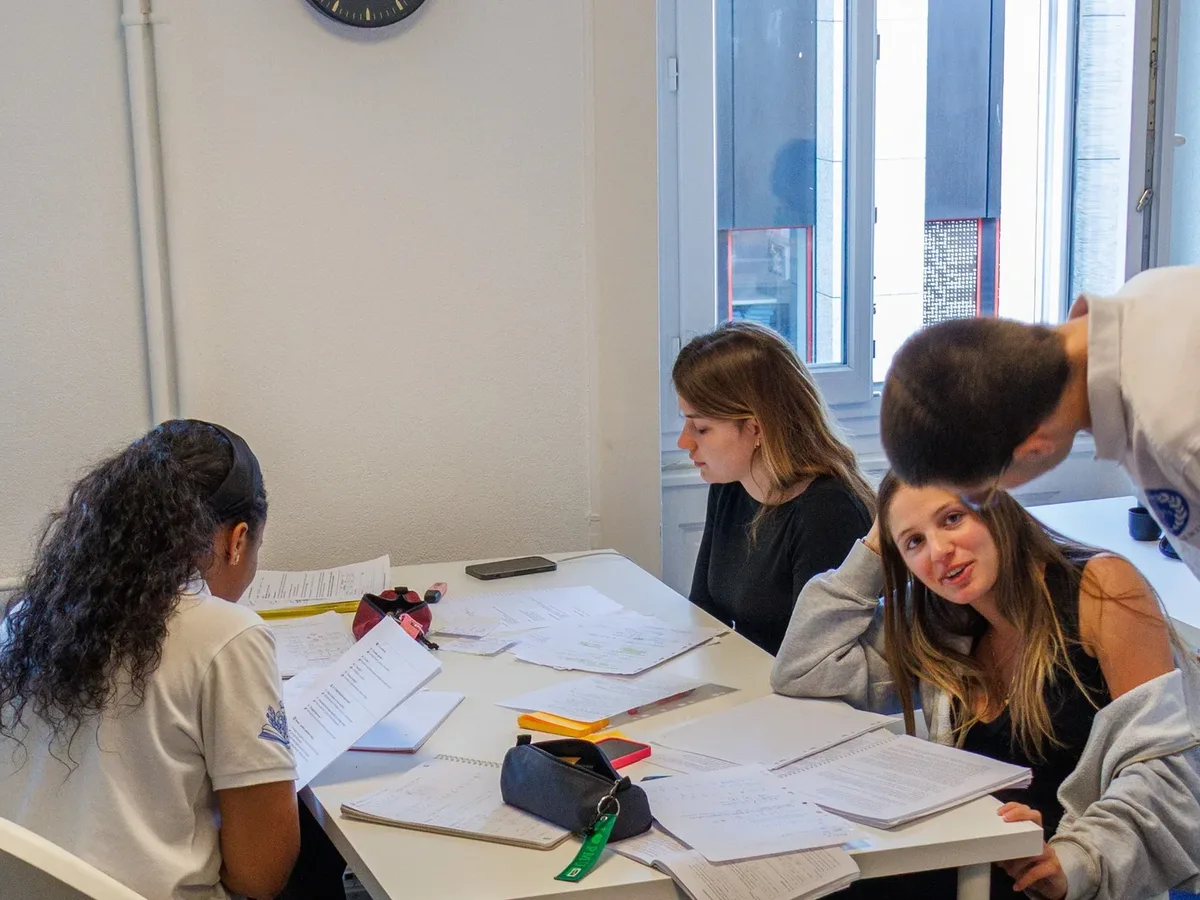
One corrected ECR example, done under real conditions, teaches more than ten past papers you cannot find. · Photo : Soutien-Omni-Scolaire
Every year, the same searches come up among Vaud parents: 'ECR Vaud 2015 French', 'ECR Vaud 2012', 'ECR 8P past papers'. The intention makes perfect sense: to prepare for a test, you want to practise on previous editions, as with a classic exam.
But for the ECR, the official reality is different. Once you understand it, you stop wasting time hunting for documents that do not exist in that form, and focus on what actually prepares your child. This guide covers it all: what the canton publishes, for which years and subjects, the 2027 and 2028 dates, the exact calculation that gives the ECR their weight, and the practice method that works.
The essentials
- 1The canton does not publish year-by-year archives: it provides one representative example per subject and per school year.
- 2Each example comes with its answer key, and with audio files when the test includes them, such as German in 8P.
- 3The ECR concern three years: 4P (French), 6P (French, maths) and 8P (French, maths, German).
- 4In 8P, an ECR weighs 30% of the subject’s annual average, the remaining 70% coming from classroom marks.
- 5One example, done under real conditions and corrected seriously, beats ten skimmed past papers.
Year-by-year past papers? What actually exists
Unlike some exams, the canton of Vaud does not release a public archive of every past ECR sorted by year. Searching 'ECR Vaud 2012' or 'ECR Vaud 2015' therefore does not lead, on the official site, to that year's full paper. Files that sometimes circulate on forums are neither complete nor guaranteed to match the current syllabus.
What the canton does provide is in fact more usable: for each school year concerned and each subject, one representative test is published as an example. That official resource, not year-by-year past papers, is what to aim for.
What an official example contains
Two details make it genuinely usable at home. First, each example comes with its answer key: your child can self-assess, and you can understand what was expected, which is often the parents’ blind spot. Second, when the test includes a listening part, such as German in 8P, the matching audio files are provided with the example.
The canton also publishes ECR results for the last five years, updated at the end of each school year. Do not confuse the two: these are cantonal statistics, useful to place an average within the canton, not test papers. They are not for practising.
“ECR Vaud 2015”, “old ECR papers”: what those searches actually find
Every year, thousands of Vaud parents look for an ECR by its year: ECR Vaud 2010, 2012, 2014, 2015, 2018, 2019, 2023, 2025. The answer is the same for all of them, and it is worth knowing before losing an evening to the search.
| What you are searching for | What actually exists | What to use instead |
|---|---|---|
| ECR Vaud 2010, 2012, 2014 | No public archive of those papers on vd.ch | The official example for the year group, matching the current curriculum |
| ECR Vaud 2015, 2018, 2019 | No year-by-year archive either, including the 2015 French paper | The same official example, together with its marking key |
| ECR Vaud 2023, 2025 | Recent papers, not released in full | The official example, plus the cantonal results of the last five years |
| Old ECR papers, ECR test | Files circulate on forums: neither complete nor guaranteed current | The official resource, the only one that is up to date and corrected |
| ECR 2027, ECR Vaud 2027 | The dates are published in advance; the papers never are | The official calendar below, and the year-group example to practise on |
In other words, the year is the wrong search criterion. An ECR from 2015 and one from 2027 assess the same curriculum objectives, in the same format and against the same marking scale. What matters is not the year of the paper, but the year group and the subject. An 8P parent practising on the official German example is working on exactly the right format, whatever year they do it in.
Which example for which year
Not every year has the same number of subjects. That is the first thing to check before looking for the right example, and it avoids downloading useless documents.
- 4P: one test only, in French. The stake is low; the main value is familiarising the child with the format of a common test.
- 6P: two tests, in French and mathematics. The results carry the weight of a significant piece of work in the year.
- 8P: three tests, in French, mathematics and German. This is the decisive year, the year of orientation.
In other words, a 6P parent has only two useful examples to retrieve, an 8P parent has three, including German with its audio. There is no point looking further: there is no science, English or history ECR in these years.
The ECR dates, in 2027 and 2028
The ECR take place in late April or early May. The official passation dates are published in advance by the canton, which allows calm preparation rather than a last-minute sprint.
Spring 2027
- 8P: Tuesday 27 April (French), Wednesday 28 April (mathematics), Thursday 29 April (German).
- 6P: Thursday 29 and Friday 30 April (French), then Monday 3 and Tuesday 4 May (mathematics).
- 4P: Thursday 29, Friday 30 April, Monday 3 and Tuesday 4 May (French).
Spring 2028
- 8P: Tuesday 9 May (French), Wednesday 10 May (mathematics), Thursday 11 May (German).
- 6P: Thursday 11 and Friday 12 May (French), then Monday 15 and Tuesday 16 May (mathematics).
- 4P: Thursday 11, Friday 12, Monday 15 and Tuesday 16 May (French).
These dates are set by the canton and communicated to families by the school. They serve as a planning marker: in 8P especially, they mark the last moment when an annual average that counts for orientation can still be influenced.
Why practise: what an ECR really changes in the average
This is the point most articles leave out, and yet it is what gives practice its meaning. In 8P, a subject’s annual average is not computed only from classroom tests: it is made of 70% classroom marks and 30% ECR results.
A worked example
Take a Year 8 pupil with a classroom average of 5.0 in mathematics. If they get 4.0 in the ECR, their annual average becomes 70% of 5.0 plus 30% of 4.0, that is 3.5 + 1.2 = 4.7, which the canton rounds to the nearest half-point: 4.5. If they get 5.0 in the ECR, it stays at 5.0. A single test day therefore takes the annual average from 5 down to 4.5.
And that half-point counts. Orientation into the pre-gymnasium track requires reaching 15 points in the restricted group, that is the combined total of French, mathematics and German, an average of 5 across those three subjects. Since the ECR cover exactly those three subjects, they weigh three times, precisely where the threshold is tightest.
That is the real reason to do an ECR example: not to "revise more", but to avoid losing tenths for nothing because of an unfamiliar format or poor time management, when the knowledge is actually there.
“Most points lost in the ECR are not lost through ignorance, but through surprise: an unfamiliar format, a misread instruction, badly divided time.”
The SOS teaching team
The method: using an ECR example in four steps
An official example is not there to revise more, it is there to revise right. Here is the method we apply with the pupils we follow, and that a parent can set up alone.
- Step 1, under real conditions: quietly, timed, with no help and no interruption. The aim is not the mark, but discovering the format and time management.
- Step 2, correction with the official answer key: calmly, a few hours or a day later, never straight away in the heat of the moment.
- Step 3, sorting the errors: separate the slip of attention, fixed by re-reading, from the underlying gap, which reveals a concept poorly learned in class.
- Step 4, targeted work: revisit only the concepts revealed in step 3, over time, rather than piling up random exercises.
Step 3 makes all the difference, and it is the one most families skip. An exercise failed through reading too fast and one failed because the concept was never understood call for opposite responses: in one case you must slow down; in the other you must relearn.
What not to do
As much as the method, it is the counterproductive reflexes that are worth identifying. We see them every spring.
- Piling up examples to "do as many as possible". One example used well beats three skimmed: analysis teaches, repetition does not.
- Looking at the score and stopping there. A mark on a practice example means nothing; what matters is the type of error.
- Cramming the week before. The ECR measure a whole year of learning: a final sprint tires more than it helps.
- Sacrificing sleep the night before. At that stage, a normal night is worth more than two extra hours of revision.
- Passing your stress on to the child. A pupil convinced their future is decided in one morning works worse, not better.
When to start: the useful calendar
Preparing for the ECR is not a spring operation. Here is how to spread it so it genuinely helps.
- September to January: do not prepare for the ECR at all, but build the basics. It is the year’s steady work that produces 70% of the average, and makes the ECR manageable.
- February and March: do a first example per subject, under real conditions, then apply the four steps. There is still time to fill what it reveals.
- April: revisit only the identified concepts, and possibly redo part of an example to check progress.
- In the days before the test: ease off. Sleep, routine, confidence. Nothing new is built at this stage.
The mock exam: the official example, but supervised
Doing an ECR example at home is good. Doing it as a mock exam is better, and it is one of the strengths of our support: the same conditions as on the day, format, duration, instructions, but with professional correction and, above all, step 3 done seriously, sorting slips of attention from underlying gaps.
What changes compared with the exercise alone is the diagnosis: the pupil comes out with a precise measure of what is missing, subject by subject, and a plan to fill it in the time left. ECR day is then no longer a discovery, it is a rehearsal.
Do you need specific ECR support?
For a steady pupil, no: a few examples done seriously are enough to tame the format. Support becomes useful when step 3 reveals underlying gaps, in French, mathematics or German, the kind that cannot be filled in a fortnight.
This is especially true in 8P, where these three subjects are both the ECR subjects and the restricted-group subjects that decide orientation. The point is not to cram the test, but to strengthen the foundations all year, so the annual average, ECR included, reflects the pupil’s true level.
In our centres in Lausanne, Vevey and Montreux, and at home across the canton, this is the work we favour: spot gaps early, fill them over time, and turn ECR examples into a diagnostic tool rather than a source of stress.
Note: dates, thresholds and procedures may change, and their application rests with the school. The information cited here comes from the canton’s official documents; for your child’s exact situation, the reference remains their school management.
Going further
Our centres
A teacher near you
- Tutoring in VeveyPassage Saint-Antoine 7, 1800 VeveyRight next to Vevey station (trains and regional buses)See the centre
- Tutoring in LausanneRue Saint-Martin 9, 1003 Lausanne2 minutes from the Bessières metro stopSee the centre
- Tutoring in MontreuxAvenue des Alpes 27B, 1820 MontreuxA few minutes’ walk from Montreux stationSee the centre
What actually changes
A specialist for each subject
Not a generalist covering everything: a teacher whose discipline it is, chosen after the assessment.
Every branch covered
Maths, French, German, English, sciences, economics and accounting, from primary school to the maturité.
Progress measured, not assumed
Every session is measured against the real Vaud thresholds: promotion points, levels, ECR, certificate.
A written report after every session
You know what was covered, what is secure and what still needs work. Without having to ask.
Soutien-Omni-Scolaire
Difficulties that persist?
A teacher who specialises in their subject, across every branch: maths, French, German, English, sciences, economics and accounting. From primary school to gymnasium, in centre, at home or online.
First conversation, no commitment
Parents' frequently asked questions
Where can I find past ECR papers in the canton of Vaud?
The canton of Vaud does not publish a year-by-year archive. On its official ECR page it provides one representative example per subject and per school year (4P, 6P, 8P), with the answer key and, where relevant, the audio files.
Can I get the ECR from a specific year, such as 2012 or 2015?
Not as a full official archive. Searching for a specific year does not return that year’s full paper. The official resource to use is the representative example per subject published by the canton.
How much does an ECR weigh in the annual average?
In 8P, a subject’s annual average is made of 70% classroom marks and 30% ECR results. In practice, a one-point difference in the ECR moves the decimal average by three tenths; since the annual average is then rounded to the half-point, that can cost or gain a full half-point.
When do the ECR take place in 2027?
In 8P: Tuesday 27 April (French), Wednesday 28 April (mathematics) and Thursday 29 April (German). In 6P: 29 and 30 April (French), then 3 and 4 May (mathematics). In 4P: 29, 30 April, 3 and 4 May (French).
How many ECR examples should you work through?
Often one, used well, is enough: done under real conditions, corrected, then analysed to separate slips of attention from underlying gaps. The number of past papers matters less than the quality of the analysis and steady work.
Do the 8P German examples include audio?
Yes. When the test includes a listening part, such as German in 8P, the matching audio files are provided with the official example.
The SOS teaching team
Tutoring · Canton of Vaud
A teaching team specialised in the Vaud school system: ECR preparation, VP and VG orientation, raccordement, gymnase entry and maturité. Centres in Vevey, Lausanne and Montreux.
Meet the SOS team →