Success · 31 August 2026
The pre-gymnasium track (VP) in Vaud: the complete parents’ guide
'VP' is one of the most frequent searches among Vaud parents, and one of the least understood. This guide explains the real mechanics of orientation with official figures: the points required, the 30% weight of the ECR, worked examples, borderline cases, bridges and what to do, month by month.
 By The SOS teaching team14 min readReviewed by the teaching team
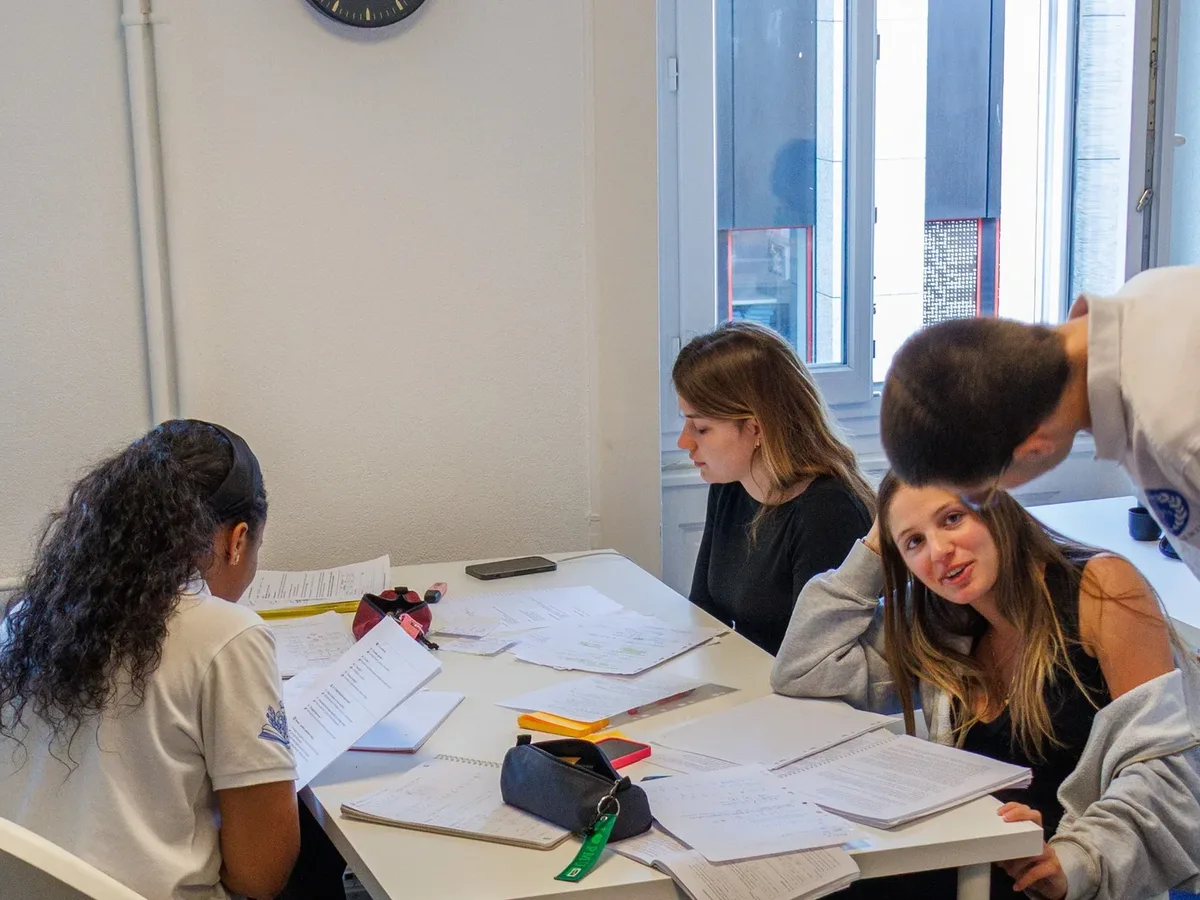
VP orientation is not decided by luck at the end of the year: it is calculated, point by point, over twelve months. · Photo : Soutien-Omni-Scolaire
Three letters keep coming up from Year 8 in the canton of Vaud: VP. Almost every parent has heard of them; very few know how orientation is actually decided. People talk about 'good marks', about 'level', sometimes about 'luck on the ECR', and rarely about the precise criteria, which are in fact public and expressed in figures.
That is the purpose of this guide: to clear the fog. We set out the official mechanics, points included, with worked examples, borderline cases, what happens if your child is placed in the general track, and what you can concretely do, month by month. Understanding the system means being able to act on it at the right moment rather than discovering the decision in June.
The essentials
- 1The VP is one of the two lower-secondary tracks (Years 9, 10, 11); it leads directly to maturity studies at gymnasium.
- 2Orientation is decided at the end of Year 8, on point thresholds: about 15 points in the restricted group (French, maths, German) and 46.5 points in the main group.
- 3The annual averages used in that calculation are made of 70% classroom marks and 30% ECR results.
- 4The real lever is the restricted group: only three subjects, so every half-mark weighs heavily.
- 5Placement in the VG is not final: bridges exist at the end of the first semester of Year 9, then at the end of Years 9 and 10.
What exactly is the VP?
From Year 9, Vaud pupils are split into two tracks within lower secondary. The pre-gymnasium track (VP) is, in official wording, the one that 'welcomes pupils who will be able to access gymnasium maturity studies directly if they obtain their lower-secondary leaving certificate'.
Put simply: the VP is the gymnasium track. A pupil who follows it through and obtains the certificate at the end of Year 11 enters gymnasium to prepare a maturity, with no additional entrance exam. That direct route explains the pressure many families feel around these two letters.
What the VP changes day to day
Beyond the principle, the VP is first experienced as a pace. The syllabus moves faster, homework is more regular, and more autonomy is expected: the pupil is assumed to be able to organise revision without being told every evening.
It is not a matter of superior intelligence. It is a matter of method and consistency. Many perfectly capable pupils struggle in the VP not because they do not understand, but because they never needed a working method before, and the pace no longer forgives improvisation.
How orientation is actually decided
Here is the heart of the matter, the part parents look for and rarely find explained clearly. The decision is not a subjective appraisal: it rests on numerical thresholds applied to the Year 8 results.
It is the school's management council that promotes the pupil, then orients them into a track and, in the general track, places them into levels. It relies on the annual averages, grouped into two sets of subjects.
The two subject groups
The restricted group covers three subjects: French, mathematics and German. The main group covers all subjects, that is, those three plus English, sciences, geography-citizenship, history-ethics, visual arts, music and creative and manual activities.
According to the official documents of the Directorate General for Compulsory Education, access to the pre-gymnasium track requires reaching about 46.5 points in the main group and 15 points in the restricted group. Those 15 points across three subjects correspond to an average of 5 in French, mathematics and German.
This should not be confused with promotion itself, which comes first and whose thresholds are lower: in the order of 40 points in the main group and 12 in the restricted group. A pupil can therefore be promoted without being oriented into the VP. Many parents discover this distinction too late.
The weight of the ECR: 30%
Each annual average used in this calculation is not simply the average of classroom tests. In Year 8 it is made of 70% classroom marks and 30% results in the cantonal reference tests (ECR), which cover French, mathematics and German.
In other words, the ECR do not decide on their own, but they weigh nearly a third, and precisely on the three subjects of the restricted group, that is, where the thresholds are tightest. It is this combination that makes Year 8 decisive.
A worked example, to make this concrete
Take a Year 8 pupil. In mathematics, the year's tests give a classroom average of 5.0. In the maths ECR, they get 4.0, an average day. Their annual maths average will be neither 5.0 nor 4.0, but the result of the calculation: 70% of 5.0 plus 30% of 4.0, that is 3.5 + 1.2 = 4.7. This average is then rounded to the nearest half-point, under a cantonal rule that is the same in every school: it becomes 4.5.
Now look at their restricted group. Say: French 5, mathematics 4.5, German 5. The total is 14.5 points, against a threshold of 15. Half a point is missing. Yet with 4.5 instead of 4.0 in the maths ECR, the calculation gave 3.5 + 1.35 = 4.85, rounded to 5: the total reached 15. Half a point in a single test would have been enough to tip it.
This is the most useful lesson in this whole article: across only three subjects, half a point gained somewhere changes an orientation. What you should aim for is not a spectacular recovery, but targeted progress where it pays most.
“In most of the cases we follow, the gap between a VP and a VG orientation is not counted in points, but in tenths.”
The SOS teaching team
"My child is right on the borderline": where to act
This is the most common situation, and the most frustrating for families. The good news is that it is also the most actionable, provided the effort is not spread thin.
The classic reflex is to make the child work 'a bit more, everywhere'. That is the opposite of what to do. The restricted group has only three subjects, and the ECR cover exactly those three. Effort concentrated on French, mathematics and German therefore acts twice: on classroom marks, and on preparation for the ECR that weigh 30%.
Second principle: aim for the most recoverable subject, not the weakest. Going from 3.5 to 4 in a subject in deep difficulty often takes more work than going from 4.5 to 5 in one that is nearly there, while both bring half a point. The arithmetic is cold, but it is fair.
Placed in VG when you were aiming for VP: what it really means
It must be said clearly, because many families experience it as a failure: the general track is not a track of relegation. It leads to general-culture and commerce schools, to vocational maturity and to apprenticeship, that is, to demanding qualifications and to trades that are hiring.
The other half of the truth must also be said: the end-of-Year-8 orientation is not final. The system explicitly provides bridges, and a fair number of pupils take them. A decision in June is not a life sentence.
The costliest mistake at that moment is not the orientation itself: it is the discouragement that follows, when the pupil concludes that 'it's over' and eases off. Yet it is precisely the first year of lower secondary that determines whether a bridge will be possible.
The bridges, with their calendar
The canton provides two distinct mechanisms, worth keeping apart.
The first is partial: a general-track pupil who is up to it can follow pre-gymnasium teaching in certain subjects, in French, mathematics, German or English. They stay in the VG but work to the VP syllabus where they are strong. This is often the first step.
The second is a full move from one track to the other. It can happen at the end of the first semester of Year 9, then at the end of Years 9 and 10, depending on results. Three windows, then, over the first two years of lower secondary.
For a parent, this points to a simple approach: if the VP goal still stands, the period not to miss is the first semester of Year 9. It is the nearest window, and the one where the gap to close is still smallest.
What to do, and when: the Year 8 calendar
An orientation is not decided in April. Here is how effort is usefully spread over the year, as we advise the families we follow.
- August to October: establish the starting point. Spot, from the first tests, which restricted-group subjects are fragile. This is the cheapest moment to correct a working method.
- November to January: consolidate the basics. This is when you fill the underlying gaps, the ones that can never be caught up in a few weeks. The first semester also gives a first realistic estimate.
- February to March: move to format practice. Do one official ECR example per subject under real conditions, then correct it to target recurring errors rather than to count points.
- Late April to early May: the ECR. By then, everything rests on regular sleep and calm, more than on last-minute revision, which does more harm than good.
- May to June: the decision. Nothing new is built there; it is the time to support the child emotionally, whatever the outcome.
Four common parental mistakes
We see them return every year, and they are costly because they are made in good faith.
- Waiting for the second semester to react. From February, few classroom marks remain to be changed: most of the annual average is already written.
- Making the child work everywhere, instead of concentrating effort on the three subjects that decide.
- Betting everything on the ECR, forgetting that they weigh only 30% and that the remaining 70% is built every week.
- Turning orientation into a question of self-worth. A child convinced their value is decided in June works worse, not better.
The mock exam: knowing where your child really stands
Everything above rests on precise thresholds, in points and tenths. Yet most parents only have an impression: 'it's going more or less fine', 'German is hard for him'. That is not enough to decide what to work on.
That is the purpose of the mock exam, and one of the strengths of our support: placing the pupil under the real conditions of the test, format, duration, requirements, then correcting and measuring the gap with what is expected for the VP. The result is not one more mark, it is a diagnosis: in which subject the tenths are lost, and why.
Done early enough in the year, it turns orientation from a verdict endured into a goal worked toward, and it stops the big day from being a surprise.
How we support that year
Our approach starts from a simple observation: since orientation plays out over three subjects and twelve months, useful support is targeted and early, not intensive and late. We begin by pinpointing exactly where the pupil loses points, in French, mathematics or German, then we work on those points over time.
In practice, that means regular lessons in the decisive subjects, ECR format practice at the right time of year, and work on method, which remains the best investment whether the pupil ends up in VP or VG. In our centres in Lausanne, Vevey and Montreux, and at home across the canton, this is the steady framework we favour.
One last word, in all honesty: no support guarantees an orientation. What can be worked on is the margin, and on thresholds decided in tenths, the margin is often enough to make the difference.
Note: thresholds and orientation procedures may change and their application rests with the school. The figures cited here come from the canton’s official documents; for your child’s exact situation, the reference remains their school management.
| Situation | What must be reached |
|---|---|
| Placement in VP at the end of 8P | Annual averages in French, maths and German, with ECR counting 30 % |
| Moving from VG to VP without repeating | Level 2 in all three subjects, specific option, 50.5 and 19 points |
| Moving from VG to VP by repeating | 46.5 and 15 points |
| Raccordement 2 (VP certificate) | Three subjects at level 2 and 46.5 / 15 points |
| Effect of one ECR point in 8P | Three tenths on the decimal average, often a half-point after rounding |
Going further
- Calculate your child's orientation and promotion
- Rac 2: joining VP after the voie générale
- 8P ECR: the three papers and their calculation
- The 9th year in VP: a tolerance cut to half a point
- The 46.5 points required for VP, and the rest of the scale
- Our mock exams under real conditions
- VP or VG: understanding orientation in 8P
- The VG and its levels 1 and 2
- The ECR: the 30% weight in 8P
- Our ECR preparation
Our centres
A teacher near you
- Tutoring in VeveyPassage Saint-Antoine 7, 1800 VeveyRight next to Vevey station (trains and regional buses)See the centre
- Tutoring in LausanneRue Saint-Martin 9, 1003 Lausanne2 minutes from the Bessières metro stopSee the centre
- Tutoring in MontreuxAvenue des Alpes 27B, 1820 MontreuxA few minutes’ walk from Montreux stationSee the centre
What actually changes
A specialist for each subject
Not a generalist covering everything: a teacher whose discipline it is, chosen after the assessment.
Every branch covered
Maths, French, German, English, sciences, economics and accounting, from primary school to the maturité.
Progress measured, not assumed
Every session is measured against the real Vaud thresholds: promotion points, levels, ECR, certificate.
A written report after every session
You know what was covered, what is secure and what still needs work. Without having to ask.
Soutien-Omni-Scolaire
Difficulties that persist?
A teacher who specialises in their subject, across every branch: maths, French, German, English, sciences, economics and accounting. From primary school to gymnasium, in centre, at home or online.
First conversation, no commitment
Parents' frequently asked questions
What does VP mean in the Vaud school system?
VP stands for voie prégymnasiale (pre-gymnasium track). It is one of the two lower-secondary tracks (Years 9 to 11) in the canton of Vaud. It prepares directly for maturity studies at gymnasium, with no additional entrance exam if the pupil obtains the certificate.
What averages are needed to be oriented into the VP?
According to the canton's official documents, you need to reach about 15 points in the restricted group (French, mathematics, German), that is an average of 5 in those three subjects, and about 46.5 points in the main group, which covers all subjects. Exact thresholds rest with the school.
What is the difference between promotion and orientation?
Promotion means moving up to the next year; its thresholds are lower (in the order of 40 points in the main group and 12 in the restricted group). Orientation is the split into VP or VG. A pupil can therefore be promoted without being oriented into the VP.
How much do the ECR weigh in orientation?
In Year 8, annual averages are made of 70% classroom marks and 30% ECR results. The ECR do not decide alone, but they weigh nearly a third, and on the three most decisive subjects.
My child was placed in VG: can they still join the VP?
Yes. A VG pupil can first follow VP-level teaching in certain subjects (French, mathematics, German or English), and a full move is possible at the end of the first semester of Year 9, then at the end of Years 9 and 10, depending on results.
What should we work on first to aim for the VP?
On French, mathematics and German. These are the three restricted-group subjects, and they are also the ones assessed by the ECR: effort there counts twice. Better to target these subjects than to work a little everywhere.
The SOS teaching team
Tutoring · Canton of Vaud
A teaching team specialised in the Vaud school system: ECR preparation, VP and VG orientation, raccordement, gymnase entry and maturité. Centres in Vevey, Lausanne and Montreux.
Meet the SOS team →