Pedagogy · 26 September 2026
The 10th year in the canton of Vaud: the year that seems quiet
The 10th year has neither ECR nor certificate, and its promotion rules are those of the 9th. So it seems quiet. Yet it is the year that closes the last reorientation between tracks and four of the five chances to change level. Here is the exact calendar, and what to do while there is still time.
 By The SOS teaching team9 min readReviewed by the teaching team
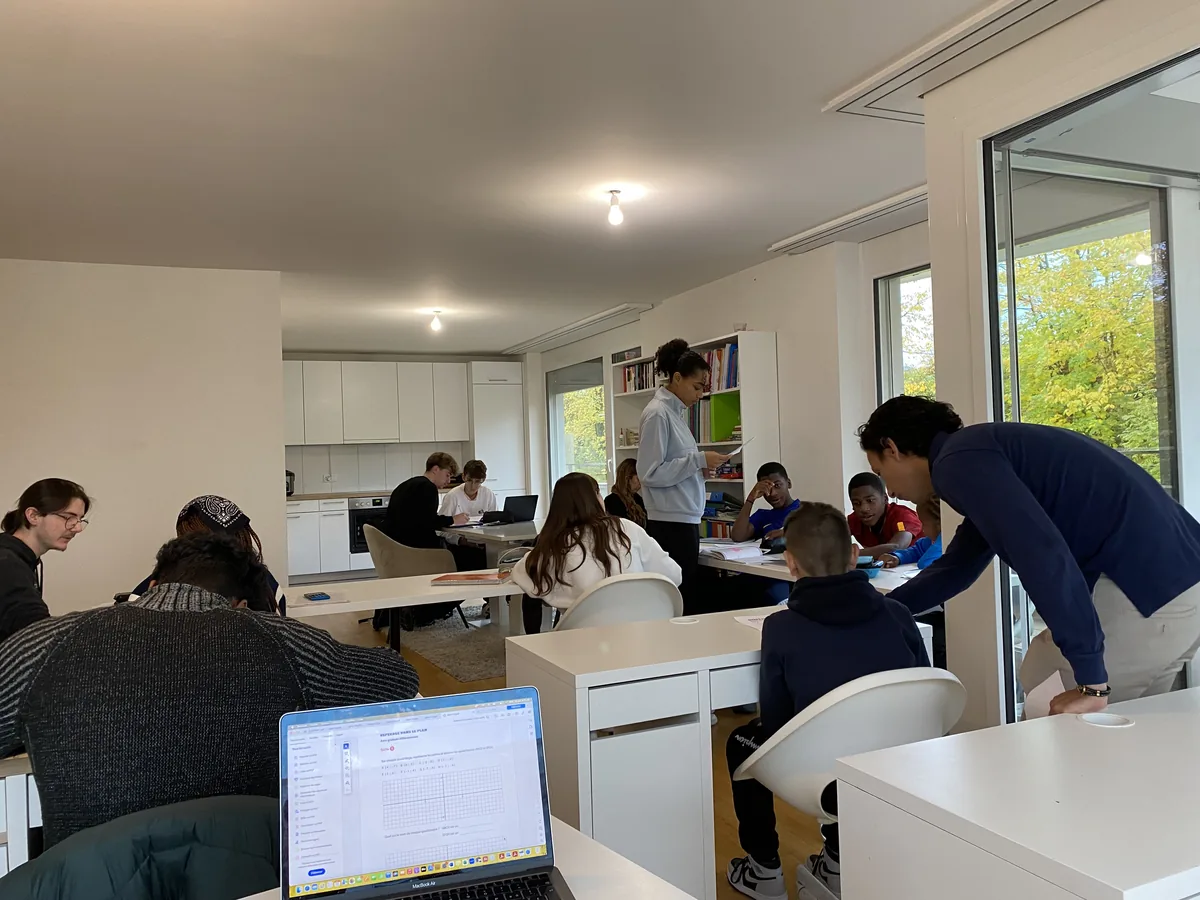
In the 10th year, the report is read first by levels: that is where what follows is decided. · Photo : Soutien-Omni-Scolaire
Why the 10th year seems quiet
The 10th year has a bad reputation, but for the wrong reason: people think nothing is at stake. There is no ECR, no orientation as in the 8th year, no certificate as in the 11th. The promotion rules are exactly those of the 9th: 44 points across eleven subjects in the main group, 16 across four in the restricted group, with a tolerance of one point per group in the voie générale and half a point in the voie prégymnasiale. Nothing new, so nothing urgent.
That is precisely the reasoning that proves costly. The 10th year does not change the rules; it closes doors. And it closes them without a dramatic report, which is why many families only notice in the 11th year, when there is nothing left to catch up.
Five chances to change level, and four pass before the end of the 10th year
In the voie générale, a student can move from level 1 to level 2 in French, maths or German at the end of each semester, from the end of the first semester of the 9th year to the end of the first semester of the 11th, from an average of 5.5, or 5 on the teacher's recommendation. That makes five opportunities in total across lower secondary.
| When | Change of level (VG) | Reorientation between tracks |
|---|---|---|
| End of 1st semester, 9th year | Move up possible (5.5, or 5 on recommendation) | — |
| End of the 9th year | Move up or down possible | Possible |
| End of 1st semester, 10th year | Move up possible | — |
| End of the 10th year | Move up or down possible — last move down | Possible — last chance |
| End of 1st semester, 11th year | Move up possible — last chance | — |
| End of the 11th year | School-leaving certificate | Raccordements afterwards |
Read this way, the calendar says it all: by the end of the 10th year, four of the five opportunities have passed. Only one remains, in January of the 11th year, and it is the hardest to seize, because it falls in the middle of the certificate year. A student entering the 11th year at level 1 in a fundamental subject therefore has, in practice, a single chance to move it up.
“The 10th year changes no rule. It simply uses up most of the chances to use them.”
The SOS teaching team
The last reorientation between tracks is decided at the end of the 10th year
Reorientations between the voie générale and the voie prégymnasiale are possible at the end of the 9th year and at the end of the 10th. After that, there are none: the student finishes lower secondary in the track they are in, and only the raccordements, after the 11th year, still allow a change of trajectory.
For a VG student aiming for gymnasium, the end of the 10th year is therefore the last chance to get there without an extra year. Moving to VP without repeating requires level 2 in the three fundamental subjects, a specific option, and 50.5 points in the main group for 19 in the restricted group. Those thresholds are not built in June; they are built from the end of the 9th year.
In the other direction, the 10th year is also the last in which a level 2 student can drop to level 1 at the end of the year, from an average of 3, or 3.5 on recommendation. A level 2 held until the end of the 10th year is therefore, barring exceptions, secured for the certificate.
What the 10th year prepares for the 11th-year certificate
The school-leaving certificate is decided in the 11th year, but it is prepared in the 10th, for two reasons families underestimate. The first concerns levels: they open or close what follows. Access to the école de culture générale from the voie générale requires 13.5 points with three level 2s, or 14.5 with two. Raccordement 2, which gives direct access to gymnasium, requires all three subjects at level 2. A level 1 that has not moved by the end of the 10th year narrows those options well before the 11th.
The second concerns the end-of-11th-year examinations, which have nothing to do with the 8th-year ECR. They cover four subjects — French, maths, German and English — include an oral, and carry 20 % of the final mark. English and the oral are the two most common weak points, and they are precisely the ones that need the most time: an oral in German is not prepared in three weeks. The 10th year is the year that time still exists.
An example: two students with the same total
Take two 10th-year students in the voie générale, both promoted with 46 points in the main group and 17 in the restricted group. On the report, they look alike. The first is at level 2 in French and maths, at level 1 in German with an average of 5. The second is at level 1 in all three subjects.
The first can still aim for level 2 in German at the end of the 10th year, on the teacher's recommendation, which would open raccordement 2 and the école de culture générale with the best margin. The second enters the 11th year with a single chance to change level, and access to the école de culture générale has become very difficult. Same total, same promotion, two very different futures. That is why, in the 10th year, the report is read first by levels.
Three things to do during the 10th year
First: identify, from September, the fundamental subject closest to the next level. That is the one to work on first, with a numerical objective — 5.5, or 5 with a recommendation — and a deadline: January or June.
Second: start on English and the oral without waiting for the 11th year. Not to revise a syllabus, but to build a regular practice that will pay off in the certificate examinations.
Third, for VG students aiming for gymnasium: raise the question of reorientation in January of the 10th year, not in June. It is the last time it arises.
How we support the 10th year
At Soutien-Omni-Scolaire, 10th-year support begins with a free assessment answering one precise question: of the opportunities that remain, which are within reach, and by when? The student then works in private lessons with a teacher who specialises in the target subject — a German teacher for German, a maths teacher for maths — rather than a generalist.
We cover every branch, English included, and we work on the oral in session, since it often separates students at the end of the 11th year. You receive a written report after every session. And our three centres in Vevey, Lausanne and Montreux, like our home lessons, schedule the work around the real Vaud calendar: the ends of semesters, not the holidays.
Note: thresholds and procedures may change from one edition of the cantonal documents to the next, and their application rests with the school. If in doubt, the school management is the authority.
Going further
What actually changes
A specialist for each subject
Not a generalist covering everything: a teacher whose discipline it is, chosen after the assessment.
Every branch covered
Maths, French, German, English, sciences, economics and accounting, from primary school to the maturité.
Progress measured, not assumed
Every session is measured against the real Vaud thresholds: promotion points, levels, ECR, certificate.
A written report after every session
You know what was covered, what is secure and what still needs work. Without having to ask.
Soutien-Omni-Scolaire
Difficulties that persist?
A teacher who specialises in their subject, across every branch: maths, French, German, English, sciences, economics and accounting. From primary school to gymnasium, in centre, at home or online.
First conversation, no commitment
Parents' frequently asked questions
Does the 10th year really count in the canton of Vaud?
Yes, even though it has neither ECR nor certificate. It is the last year in which a reorientation between tracks is possible, and by its end, four of the five chances to change level in the voie générale have already passed.
How many points are needed to move from the 10th to the 11th year?
The same as in the 9th: 44 points in the main group and 16 in the restricted group, which gathers French, maths, German and the option. The tolerance is one point per group in the voie générale and half a point in the voie prégymnasiale.
Can a student still move from VG to VP after the 10th year?
Not directly: the end of the 10th year is the last reorientation opportunity in lower secondary. After the 11th year, only the raccordements still allow a student to join the voie prégymnasiale or gymnasium.
When is the last change of level in the voie générale?
The last possible move up is at the end of the first semester of the 11th year. The last possible move down is at the end of the 10th. There are five chances in all to move up, from the end of the first semester of the 9th year to the end of the first semester of the 11th.
What should be prepared in the 10th year for the 11th-year examinations?
English and the oral. The end-of-11th-year examinations cover four subjects, English included, include an oral and carry 20 % of the final mark. They are the two most common weak points, and the ones that need the most time.
The SOS teaching team
Tutoring · Canton of Vaud
A teaching team specialised in the Vaud school system: ECR preparation, VP and VG orientation, raccordement, gymnase entry and maturité. Centres in Vevey, Lausanne and Montreux.
Meet the SOS team →