Pedagogy · 25 September 2026
The 9th year in the canton of Vaud: what really changes in lower secondary
The 9th year keeps the 8th year's calculation logic but changes three rules almost nobody explains to parents: the option enters the restricted group, the voie générale introduces levels decided each semester, and borderline tolerance differs by track. Here is what that changes in practice, with a January report worked through.
 By The SOS teaching team11 min readReviewed by the teaching team
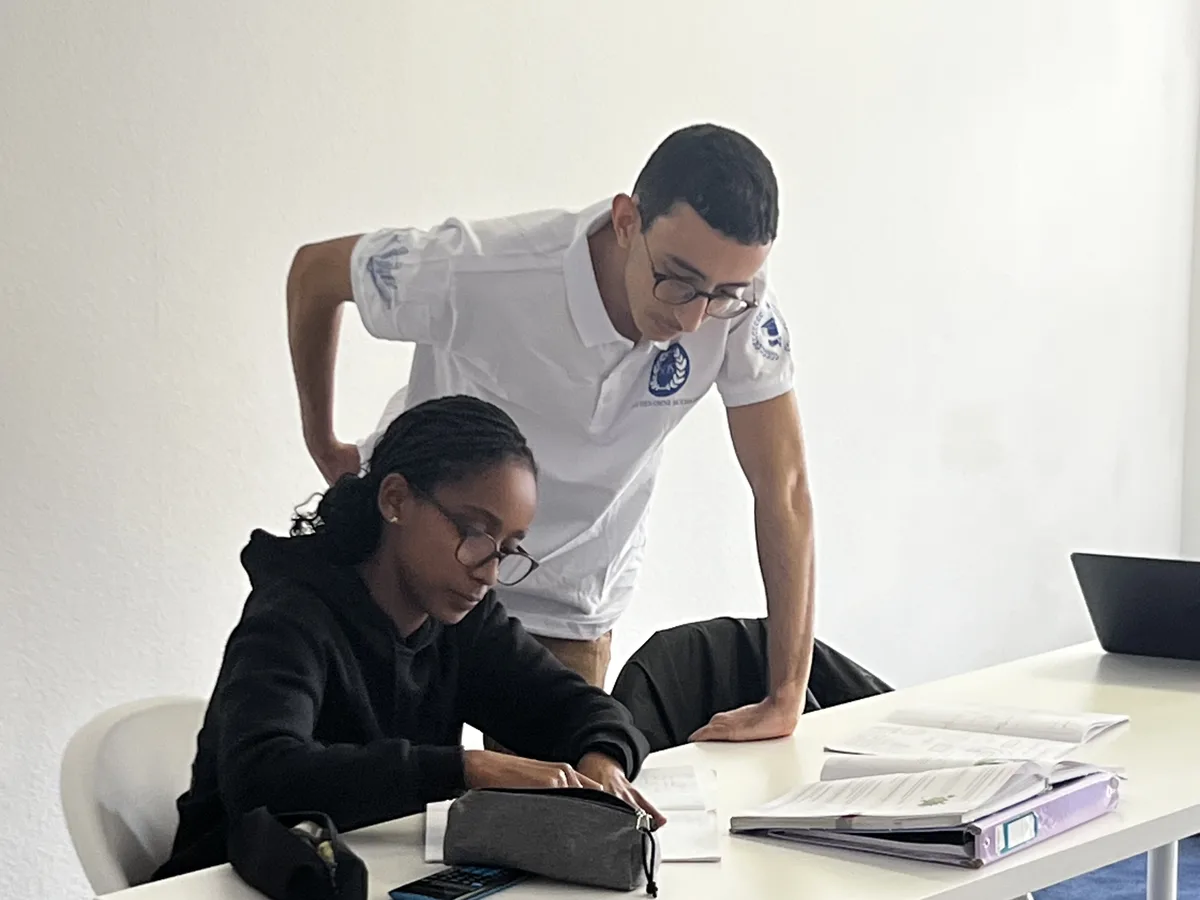
The 9th year is the first in which the January report decides something: a change of level. · Photo : Soutien-Omni-Scolaire
What does not change: every threshold still means an average of 4
Let us start with reassurance. The calculation logic your child knew in the 8th year remains exactly the same in the 9th: decisions are taken on point totals by groups of subjects, and every threshold corresponds to the number of subjects in the group multiplied by 4. In the 8th year, 40 points over ten subjects and 12 over three were required. In the 9th, 44 over eleven and 16 over four. The principle is identical; it is the groups that have changed.
Marks still run from 1 to 6, rounded to the nearest half point, and it is still the rounded mark that enters the totals. The report is still issued twice a year. A parent who understood the 8th-year mechanism therefore does not have to relearn everything. They have three precise things to learn, and they matter.
First change: the option enters the restricted group
This is the change with the heaviest consequences, and the least explained. In the 8th year, the restricted group counted only three subjects: French, maths, German. In the 9th, a fourth is added: the option. In the voie prégymnasiale, it is the specific option. In the voie générale, it is the craft, artistic, commercial or technological option, or a specific option.
In other words, the subject your child chose in the spring of their 8th year is not a leisure subject: from September, it weighs exactly as much as French or maths in the most binding total on the report. A poorly chosen or neglected option can, on its own, push the restricted group below 16 points while the other three subjects hold.
Many families discover this at the first report. It is better to know it in September, because the option is also the subject in which a motivated student gains points fastest: it is the one they chose.
Second change: levels, and a semester-based calendar
In the voie générale, the 9th year introduces a mechanism the 8th did not have: French, maths and German are now taught at two levels. Level 1 corresponds to basic requirements, level 2 to higher requirements. Each student is placed, subject by subject, on entering the 9th year, on the basis of their 8th-year annual average.
That placement is not fixed, and this is where the calendar changes. A move from level 1 to level 2 can occur at the end of each semester, from the end of the first semester of the 9th year, from an average of 5.5, or 5 on the teacher's recommendation. In the other direction, a return to level 1 is decided at the end of the year, from an average of 3 or below, or 3.5 on recommendation.
The consequence is simple and many parents miss it: in the 9th year, the January report is a real deadline. It is the first opportunity to move up a level. A student placed at level 1 in German who reaches 5.5 in the first semester can be at level 2 in February. Waiting for June means losing half the year's opportunities.
“In the 8th year, everything was decided in June. In the 9th, part of it is decided in January. That is the first reflex to change.”
The SOS teaching team
Third change: the tolerance depends on the track
In the 8th year, the margin allowed for borderline cases was the same for everyone: at most one point of insufficiency per group. In the 9th, it differs. In the voie générale, it remains one point per group. In the voie prégymnasiale, it drops to half a point.
In practice, a VP student at 43.5 points in the main group is still within tolerance; at 43, they are not. The same total in VG remains recoverable. VP is therefore, from the 9th year, twice as unforgiving as VG — consistent with what it promises, direct access to gymnasium, but a surprise for families who experienced the 8th year as a year of margin.
| End of 8th year | 9th year | |
|---|---|---|
| Restricted group | French, maths, German — 12 points | French, maths, German, option — 16 points |
| Main group | 10 subjects — 40 points | 11 subjects — 44 points |
| Levels in VG | Do not exist yet | Level 1 or 2 in French, maths, German |
| Change of level | — | End of each semester, from January of the 9th year (5.5, or 5 on recommendation) |
| Borderline tolerance | 1 point per group, for everyone | VG: 1 point per group. VP: 0.5 point |
| Reorientation between tracks | Initial orientation | Possible at the end of the 9th and 10th years |
A worked example: the first 9th-year report
Take a 9th-year student in the voie générale, placed at level 1 in German and level 2 in French and maths. Their January report shows: French 4.5, maths 4, German 5.5, option 4, English 4, sciences 4.5, geography 4, history 4, visual arts 5, music 4.5, creative activities 4.5.
Restricted group: 4.5 + 4 + 5.5 + 4 = 18 points, threshold of 16 exceeded. Main group: 18 + 4 + 4.5 + 4 + 4 + 5 + 4.5 + 4.5 = 48.5 points, threshold of 44 exceeded. Nothing to fear on the promotion side. But the figure that really matters on this report is the 5.5 in German: it opens a move to level 2 from February. That is what to look at first, and that is what to raise with the teacher.
The same student with a 5 in German does not have the automatic move, but can obtain it on the teacher's recommendation. That is the moment to ask for a meeting, not to wait for June.
VP in the 9th year: what the specific option commits to
In the voie prégymnasiale, the specific option chosen in the 9th year is not just one more subject: it already shapes what follows. It weighs in the restricted group for three years, it conditions certain bridges, and it prepares the gymnasium options. A student hesitating between two options at the end of the 8th year should think in terms of three years, not one.
And VP's reduced tolerance means that a single subject at 3.5 already uses up the group's entire margin. The work, in VP, is not about shining somewhere but about letting no subject slip.
VG in the 9th year: aim for level 2 from the first semester
In the voie générale, the 9th-year stake is clear: reach level 2 in as many of the three fundamental subjects as possible, as early as possible. Because levels do not condition promotion, but they condition everything else: the move to VP, which requires level 2 in all three, raccordement 2, which requires it too, and access to the école de culture générale, which asks for 13.5 points with three level 2s or 14.5 with two.
A VG student finishing the 9th year with three level 2s has every bridge ahead of them. A student finishing with three level 1s has almost none, whatever their overall average. That is why, in VG, the report is read first by levels, and only then by points.
Reorientation between tracks: possible from the end of the 9th year
The orientation at the end of the 8th year is not final. Reorientations between the voie générale and the voie prégymnasiale are possible at the end of the 9th and 10th years. Moving from VG to VP without repeating requires level 2 in the three fundamental subjects, a specific option, and 50.5 points in the main group for 19 in the restricted group. By repeating, the thresholds are 46.5 and 15.
These figures are high, and rightly so: they correspond to an average well above 4. But they are built from September of the 9th year, and one well-run semester in a single subject can be enough to unlock a level. Reorientation is not decided in June; it is prepared from January.
Four parental mistakes in the 9th year
The first is treating the option as a secondary subject. It counts in the restricted group, on a par with French.
The second is reading the January report as mere information. In VG, it is the first window for a change of level; in VP, it is the first measure of a tolerance twice as narrow.
The third is taking comfort in the main group total. A student at 48 points can be stuck at level 1 in all three fundamental subjects, with no bridge ahead of them.
The fourth is believing VG closes doors. It does not close them; it conditions them on levels, and those levels are worked on semester by semester.
How we support the 9th year
At Soutien-Omni-Scolaire, the 9th year begins with a free assessment that does two things: it checks what remains secure from the 8th year, and it places the student against the new rules — which track, which levels, which option, which tolerance. It is not a general level test; it is a reading of the year's calendar.
The student then works with a teacher who specialises in the target subject, chosen after the assessment rather than at random. We cover every branch of the main group, from maths to economics. And you receive a written report after every session, saying what was covered, what is secure, and what still needs work before the next deadline.
Our three centres in Vevey, Lausanne and Montreux take 9th-year students after school; home lessons cover the rest of the canton. The best time to start is September, while it is still a matter of adjusting rather than catching up.
Note: thresholds and procedures may change from one edition of the cantonal documents to the next, and their application rests with the school. If in doubt, the school management is the authority.
Going further
- Next: the 10th year, the year that seems quiet
- Tutoring in Lausanne: the Saint-Martin centre
- The Vaud report explained: every threshold, year by year
- The voie générale (VG) and its levels 1 and 2
- The voie prégymnasiale (VP): the complete guide
- Promotion, orientation, certification: the three decisions
- Our mock exams under real conditions
What actually changes
A specialist for each subject
Not a generalist covering everything: a teacher whose discipline it is, chosen after the assessment.
Every branch covered
Maths, French, German, English, sciences, economics and accounting, from primary school to the maturité.
Progress measured, not assumed
Every session is measured against the real Vaud thresholds: promotion points, levels, ECR, certificate.
A written report after every session
You know what was covered, what is secure and what still needs work. Without having to ask.
Soutien-Omni-Scolaire
Difficulties that persist?
A teacher who specialises in their subject, across every branch: maths, French, German, English, sciences, economics and accounting. From primary school to gymnasium, in centre, at home or online.
First conversation, no commitment
Parents' frequently asked questions
What changes between the 8th and 9th years in the canton of Vaud?
Three things. The option enters the restricted group, which goes from three to four subjects and from 12 to 16 points. In the voie générale, French, maths and German are now followed at two levels, with changes possible at the end of each semester. And the borderline tolerance differs: one point per group in VG, half a point in VP.
How many points are needed to move from the 9th to the 10th year?
44 points in the main group, which gathers the eleven subjects, and 16 in the restricted group, which gathers French, maths, German and the option. Both thresholds must be met. Each corresponds to an average of 4 across the group's subjects.
Can a student change level during the 9th year?
Yes. A move from level 1 to level 2 is possible at the end of each semester, from the end of the first semester of the 9th year, from an average of 5.5 or 5 on the teacher's recommendation. A return to level 1 is decided at the end of the year, from an average of 3 or 3.5 on recommendation.
Does the option really count towards promotion?
Yes, decisively: in the 9th year, the option is part of the restricted group, on a par with French, maths and German. A neglected option can push that group below 16 points even if the other three subjects hold.
Can a VG student still move to VP after the 9th year?
Yes. Moving without repeating requires level 2 in the three fundamental subjects, a specific option, and 50.5 points in the main group for 19 in the restricted group. By repeating, the thresholds are 46.5 and 15. Reorientations are possible at the end of the 9th and 10th years.
Why is the January report of the 9th year important?
Because in the voie générale it is the first opportunity to move from level 1 to level 2, and in the voie prégymnasiale it is the first measure of a tolerance reduced to half a point per group. In the 8th year, everything was decided in June; in the 9th, part of it is decided in January.
The SOS teaching team
Tutoring · Canton of Vaud
A teaching team specialised in the Vaud school system: ECR preparation, VP and VG orientation, raccordement, gymnase entry and maturité. Centres in Vevey, Lausanne and Montreux.
Meet the SOS team →