Advice for Parents · 24 September 2026
Homework help in the canton of Vaud: supervised homework, study hall or private lesson?
'Homework help' means three very different things in the canton of Vaud, and parents often realise it too late. The commune's supervised homework is not academic support: that is stated explicitly in the texts. Here is what each solution really covers, what it costs, and how to choose.
 By The SOS teaching team12 min readReviewed by the teaching team
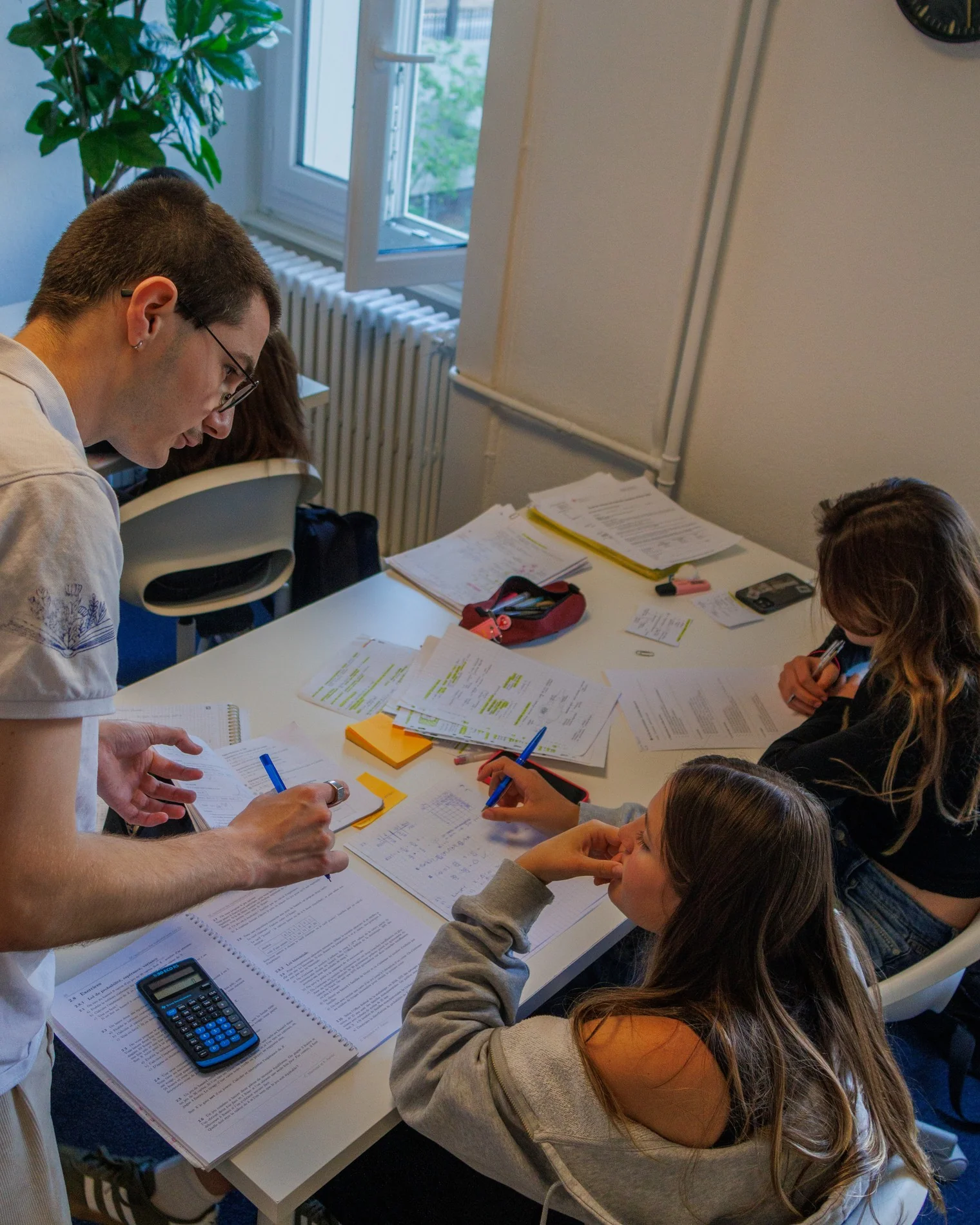
Making sure homework gets done, or understanding why it does not: these are two different jobs. · Photo : Soutien-Omni-Scolaire
'I am looking for homework help for my son.' We hear this sentence every week, and it actually covers three very different arrangements, with roles, prices and above all results that have nothing in common.
The most costly misunderstanding concerns the supervised homework organised by the communes. Many families enrol their child thinking they are solving a school problem, and discover in January that the marks have not moved. This is not a failure of the scheme: it is simply not its mission, and the official texts say so explicitly.
The essentials
- 1Supervised homework is organised and financed by the commune, from Year 3, at least three days a week (legal basis: LEO, articles 29 and 132).
- 2It is not academic support: the staff’s role is to ensure the time is used to do homework; pedagogical help is not compulsory.
- 3The cost is modest: in Vevey, from 25 to 100 francs per semester depending on the number of days.
- 4A tuition centre’s study hall adds what supervised homework does not: a teacher who explains the concept that was not understood.
- 5A private lesson becomes necessary when the problem is no longer evening work, but an established gap.
The commune’s supervised homework: what it really is
It is the most widespread solution, and the cheapest. In the canton of Vaud, supervised homework is a commune matter, not a cantonal one: the law on compulsory schooling (LEO) places responsibility for this time under article 29, and its financing on the communes under article 132.
In practice, parents may enrol their child from Year 3. The scheme is offered at least three working days a week, in premises provided by the commune, most often school premises. The commune hires the staff and oversees the quality of supervision; sometimes they are teachers, sometimes not.
The point almost nobody reads
And here is the decisive sentence, the one that explains so many disappointments: supervised homework is not academic support. The staff’s role is to ensure that this time is devoted to doing homework. Pedagogical help is not an obligation of the scheme.
The primary school of Vevey states it unambiguously on its own page: supervised homework offers help in completing homework and "is not academic support intended to fill gaps or delays" in learning.
This is not a criticism of the scheme, which renders families an immense service. It is a framing: it ensures homework gets done; it does not repair a concept misunderstood in Year 6.
The cost, on a real example
Rates vary from one commune to another. As an example, the primary school of Vevey charges per semester according to frequency: 25 francs for one day a week, 50 for two, 75 for three, 100 for four. Sessions are held on Monday, Tuesday and Thursday from 3.30 to 5.30 p.m., and Wednesday from 2 to 4 p.m. in certain buildings.
At that price, for an independent child who simply needs a quiet setting and a fixed schedule, it is the best solution in the canton. You just need to know what you are buying.
A centre’s study hall: the step above
This is the intermediate formula, and the one parents know least. The principle is the same, a supervised time after school to do homework, but with one decisive difference: the supervisor is a teacher, and they explain.
In other words, when a pupil gets stuck on a maths exercise because they did not understand the concept in class, they do not simply skip the question or copy the answer. Someone goes back over the concept with them. That is precisely what communal supervised homework does not commit to doing.
The group is small, the follow-up is the same all year, and parents receive a report. This formula suits the pupil who does work, but who accumulates small misunderstandings for lack of being able to ask questions.
The private lesson: when the problem is no longer homework
There comes a point when no evening supervision is enough, and it is recognised by a simple sign: the child does their homework, properly, and the marks do not rise.
That means the problem is no longer work organisation, but a gap established upstream, sometimes years earlier. A Year 9 pupil struggling with equations often has a fractions problem dating from Year 7. No evening supervision repairs that, because it is not in the day’s homework.
A private lesson works on something else: identifying the original gap, rebuilding it, then making it automatic. It is diagnostic work, not accompaniment.
How to choose, in three questions
Rather than a comparison table, ask yourself these three questions in order. The first one you answer "no" to points to the formula you need.
- Does my child do their homework when given a framework? If not, the commune’s supervised homework is probably enough: what is missing is a schedule and a quiet place.
- Do they understand what they are doing, or do they move forward without knowing why? If they get stuck and cannot ask their question, they need a study hall with a teacher.
- Do they work seriously without the results following? Then the problem is an underlying gap, and only targeted lessons will repair it.
“A child who does their homework and whose marks stagnate does not have a homework problem. They have a hole in the foundations.”
The SOS teaching team
Three frequent parent mistakes
- Waiting until January to notice that supervised homework has not solved a comprehension problem. The scheme never promised to.
- Going straight to private lessons for a child who is simply disorganised. That is paying for a repair where a framework was needed.
- Stacking schemes without a diagnosis. Three hours of poorly targeted supervision tire the child without rebuilding anything.
What we do, and what we do not do
We do not offer supervised homework in the communal sense: for that, your commune does it better and cheaper, and we say so to families who call us about it.
What we offer is study halls supervised by teachers, and individual or semi-private lessons when the diagnosis shows an underlying gap. The free pedagogical assessment exists precisely to decide between the two, and sometimes to send you back to the communal solution when that is the right one.
In our centres in Lausanne, Vevey and Montreux, as at home across the canton and online, it is this diagnosis that guides the formula, never the other way round.
Note: as supervised homework is a commune matter, its times, rates and arrangements vary from one commune to another. The figures cited for Vevey are those published by its primary school and serve as an example; check with your own commune for your situation.
Going further
What actually changes
A specialist for each subject
Not a generalist covering everything: a teacher whose discipline it is, chosen after the assessment.
Every branch covered
Maths, French, German, English, sciences, economics and accounting, from primary school to the maturité.
Progress measured, not assumed
Every session is measured against the real Vaud thresholds: promotion points, levels, ECR, certificate.
A written report after every session
You know what was covered, what is secure and what still needs work. Without having to ask.
Soutien-Omni-Scolaire
Difficulties that persist?
A teacher who specialises in their subject, across every branch: maths, French, German, English, sciences, economics and accounting. From primary school to gymnasium, in centre, at home or online.
First conversation, no commitment
Parents' frequently asked questions
Is supervised homework academic support?
No. In the canton of Vaud, the role of supervised-homework staff is to ensure the time is used to do homework; pedagogical help is not an obligation of the scheme. The primary school of Vevey states it is not intended to fill gaps or delays.
Who organises and finances supervised homework in the canton of Vaud?
The communes. The law on compulsory schooling (LEO) places responsibility for this time under article 29 and its financing on the communes under article 132. Times and rates therefore vary from one commune to another.
From which year can a child be enrolled in supervised homework?
From Year 3. The scheme is offered at least three working days a week, in premises provided by the commune, most often school premises.
How much does supervised homework cost?
It depends on the commune. In Vevey, the primary school charges per semester: 25 francs for one day a week, 50 for two, 75 for three and 100 for four days.
What is the difference with a tuition centre’s study hall?
The supervisor is a teacher and explains the concept that was not understood, instead of only ensuring homework gets done. The group is small, follow-up lasts all year and parents receive a report.
When should you move to private lessons?
When the child does their homework seriously and the marks do not rise. That is the sign the problem is no longer work organisation but an established gap that no evening supervision repairs.
The SOS teaching team
Tutoring · Canton of Vaud
A teaching team specialised in the Vaud school system: ECR preparation, VP and VG orientation, raccordement, gymnase entry and maturité. Centres in Vevey, Lausanne and Montreux.
Meet the SOS team →