Advice for Parents · 20 August 2026
Maths tutor, private tutor or homework help: how to choose in the canton of Vaud
Becoming an online tutor takes ten minutes: a photo, two sentences, a price. No level test, no teaching test, no supervision. Here is how to recognise genuinely serious support, the precise questions to ask, and what we impose on ourselves at SOS so you never have to take our word for it.
 By The SOS teaching team12 min readReviewed by the teaching team
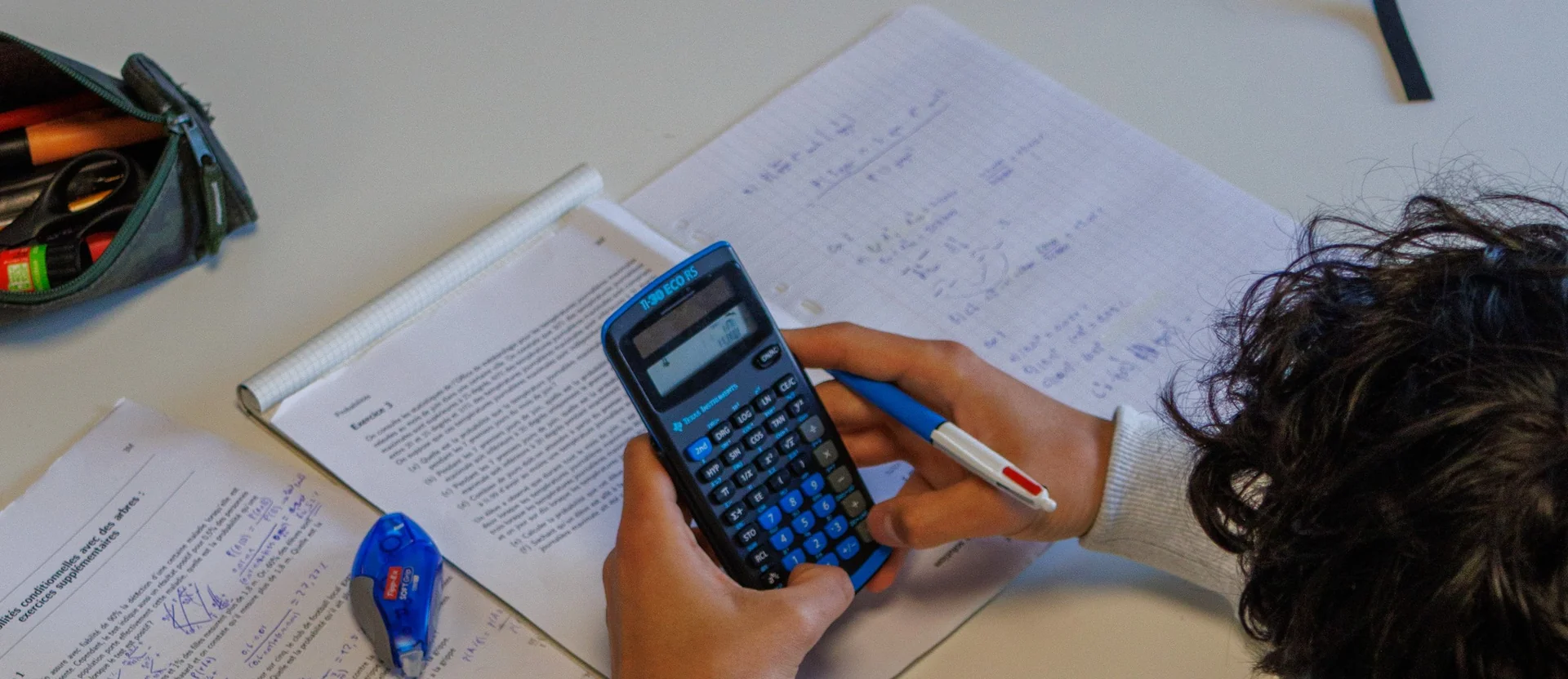
Maths, calculator in hand: the subject most requested in our centres, and the one where the teacher’s competence weighs heaviest. · Photo : Soutien-Omni-Scolaire
A parent looking for help for their child rarely types the same thing twice into Google: maths tutor, private teacher, homework help, academic support. Behind these words the need is identical: someone competent, who understands where the student is stuck, rebuilds what is missing and is accountable. And behind these words lies the real difficulty: nothing in an online listing tells you about the person's actual ability to teach.
Let us say it upfront: there are excellent independent teachers, just as there are excellent teachers in centres. This article does not set out to tell you who is good and who is not, which would be dishonest. It sets out to give you the criteria that genuinely make the difference, so that you can choose knowingly. The real question is not 'who is best?', it is 'what level of selection, follow-up and continuity do you want around your child's teacher?'.
In a hurry? The six points to check
- 1Has the teacher passed a teaching test, not just an interview?
- 2Does anyone review their work over time, or do you depend on their own self-assessment alone?
- 3What do you receive, in writing, after each session?
- 4How is the origin of the difficulties diagnosed, beyond the week's exercises?
- 5Is the price displayed in full, fees included, and comparable?
- 6What happens, concretely, if it does not click with the teacher?
The rest of this article explains why these six points matter, what the different options available in the canton are worth, and how we answer them at SOS. You can use it to assess us just as much as anyone else.
Becoming an online tutor takes ten minutes
Open any matching platform: creating a tutor profile requires a photo, a few sentences of introduction and a price. Some platforms verify identity or the diplomas claimed, and that is useful. But verifying a profile or a diploma says nothing about how the person teaches in front of a student, and nobody will observe what happens during the lessons. The platforms themselves are open about it: they are directories that connect people, not schools that supervise.
The consequence lands on you. You have to assess, in someone you do not know, the hardest skill there is to judge: not knowing maths, but making maths understood. Without a test or a common benchmark, the measuring instrument left to you arrives months later: your child's report card. By the time it arrives, the semester is gone.
Knowing a subject and knowing how to teach it: two different professions
This is the most expensive misunderstanding in tutoring. Having passed maths, even brilliantly, does not qualify anyone to teach it. Teaching is something else: diagnosing where understanding stopped, sometimes years earlier; re-explaining a notion differently from the class, then differently again if the second explanation does not land; choosing the right exercise at the right moment; keeping a discouraged student at work who has decided they are 'bad at maths'.
A student who is excellent in their field can be a remarkable teacher. They can also be a mediocre one, who explains the way they themselves understood and grows impatient when that is not enough. Without a teaching test, nobody can know in advance. Not even them.
“A student does not progress because their teacher knows. They progress because their teacher knows how to transmit.”
The SOS teaching team
The six questions that separate the offers
Whether you choose SOS or anyone else, ask these six questions. A serious counterpart answers them precisely and without taking offence. Evasive answers are, in themselves, an answer.
- Has the teacher passed a teaching test, not just an interview? A diploma shows they know the subject. A teaching test assesses, before a student is entrusted to them, how they explain it.
- Who looks at the teacher's work over time? A teacher working alone can be excellent and self-critical; you simply depend on their own self-assessment. Ask whether a second pair of eyes exists, and how often it is applied.
- What do you receive after each session? If the answer is 'nothing', you will discover in October what you could have known in September.
- How is the origin of the difficulties diagnosed? 'We will go over what is seen in class' treats the symptoms. A real diagnosis goes back to the source, often older than the current school year.
- Is the price displayed, complete, comparable? Beware of teaser rates that state neither the level, nor the duration, nor extra fees.
- What happens if it does not click? The right answer is a simple, quick replacement. The wrong one: a commitment that locks you in with the wrong person.
The three main options in the canton of Vaud
Matching platforms first. Their strengths are real: hundreds of profiles, quick comparison, often low rates, and someone found within days. They are a good tool when the need is one-off, revising a chapter before a test, for example. Their limit is not a manufacturing defect, it is their model: the platform connects, it does not supervise. Selection, tracking of progress and the reaction when things do not work remain your responsibility.
Word of mouth next: the student from the neighbourhood, the acquaintance with a science degree. Sometimes excellent, often cheap, and the direct relationship has real virtues: continuity, flexibility, trust already established. It is a very good choice when you personally know the person and know that they can teach. The limit is dependence: everything rests on them alone, and if it does not click, nothing will have flagged it before the marks do.
Centres with a teaching team, finally. Their value fits in one sentence: quality there depends less on a single person. The teacher is tested before meeting their first student, their work is reviewed by supervisors, sessions are documented, and they can be replaced if the profile does not fit. It is the most relevant option when difficulties persist, span several topics or require months of follow-up. It costs more than hiring a student directly, and that is logical: you are not paying only for the hour of teaching, you are paying for the selection, the follow-up and the continuity that surround it.
How SOS selects and supervises its teachers
Rather than asking you to believe us, here is precisely what we impose on ourselves, point by point. Compare it with any other offer: that is exactly the exercise we recommend.
- A teaching test before the first lesson. Our candidate teachers sit demanding assessments before teaching with us: mastering the subject is not enough, they must demonstrate in front of an assessor that they can explain it.
- Assignment decided from the assessment. We do not send 'an available teacher': starting from the initial assessment, we look for the teacher best suited to the subject, the level, the difficulties identified and the student's profile.
- Teaching supervisors who review the teachers' work. Our teachers do not work alone in their corner: their sessions, their reports and their students' progression are regularly reviewed by teaching supervisors.
- A written report to parents after every session. You know what was worked on, what is improving and what remains fragile. It is also an instrument of control: a teacher who documents every session is a teacher who exposes themselves to your scrutiny, and to ours.
- Continuous evaluation. Our teachers are evaluated over time, through the reports, the students' measurable progress and the families' feedback. Teaching well at SOS is not an acquired status, it is a permanent requirement.
- A simple replacement if the profile does not fit. No chemistry? We change teacher, simply and quickly. Your commitment is to your child's progress, not to one person.
Trust is not declared: it is verified
Anyone can write 'qualified teachers' on a website. Here are three concrete ways to verify us before paying anything. The free educational assessment first: you meet our team, you see our diagnostic method, and you leave with a recommendation, whether you continue with us or not. Google reviews next: they are public, verified, left on our centres' listings by real families, and we never publish an invented testimonial. Fees finally: they are fully displayed on our site, identical for every family, with no mystery quotes.
And once lessons have started, the checking continues: the report after every session lets you see, week after week, whether the support really matches what you were told.
The special case of maths
Maths stacks up, and the chain is easy to picture: division, then fractions, then algebraic manipulation, then equations, then functions. Each link assumes the previous one. That is why an apparent difficulty with functions in Year 9 can originate several years earlier, in fractions or algebraic manipulation, without anything flagging it at the time. Redoing the week's exercises calms the symptoms; finding the link where the chain broke, and rebuilding from there, treats the cause.
This is the criterion that best separates maths offers: ask how the person intends to identify the origin of the difficulty. If the answer is 'we will go over what is seen in class', you have a répétiteur in the strict sense. If the answer starts with a diagnosis of the real level, you have genuine support.
Homework help, private lessons, supervised study: which formula for which need?
One last point of method: the right teacher in the wrong formula delivers far fewer results. If the difficulty is focused on one subject, a one-to-one or semi-private lesson with a private teacher is the most direct answer. If the need is broader, homework done and understood every week, a regular working frame, several subjects to hold at once, then it is the structured homework help of our supervised study you should look at: homework is done, checked and understood at every session, tests are anticipated, marks followed all year, with the same report to parents. And if the need is genuinely one-off, a few hours before a test may be enough: we say so when that is the case. The initial assessment exists precisely to point to the right formula, not the most expensive one.
How it works at SOS, concretely
Everything starts with a free, no-obligation educational assessment, which establishes your child's real level and the origin of their difficulties. We then assign the teacher suited to their profile, one-to-one or semi-private, at our centres in Vevey, Lausanne and Montreux, at home across the Riviera and the Lausanne region, or online. After every session, you receive your written report.
Rates are fully displayed: CHF 70.- per hour for one-to-one lessons at the single-session rate (80.- at secondary II level), 50.- per hour per student in semi-private, and hour packs that bring the price down to 48.40 per hour one-to-one and 30.80 in semi-private. Supervised study starts at 240.- per month. No mystery quotes: everything is on the pricing page.
The essentials
- 1Becoming an online tutor takes ten minutes: no level test, no teaching test, no supervision. The risk rests entirely on the parent.
- 2Knowing a subject and knowing how to teach it are two professions: only a teaching exam, before the first lesson, tells them apart.
- 3Six questions separate the offers: teaching exam, supervision over time, a report after every session, diagnosis of the origin of the difficulties, complete displayed price, easy replacement.
- 4At SOS: teachers tested through demanding exams before they teach, closely followed by teaching supervisors, continuously evaluated, with a written report after every session.
- 5Trust is verified before paying: free assessment, public Google reviews from real families, fully displayed rates, in Vevey, Lausanne and Montreux.
Going further
What actually changes
A specialist for each subject
Not a generalist covering everything: a teacher whose discipline it is, chosen after the assessment.
Every branch covered
Maths, French, German, English, sciences, economics and accounting, from primary school to the maturité.
Progress measured, not assumed
Every session is measured against the real Vaud thresholds: promotion points, levels, ECR, certificate.
A written report after every session
You know what was covered, what is secure and what still needs work. Without having to ask.
Soutien-Omni-Scolaire
Difficulties that persist?
A teacher who specialises in their subject, across every branch: maths, French, German, English, sciences, economics and accounting. From primary school to gymnasium, in centre, at home or online.
First conversation, no commitment
Parents' frequently asked questions
How are SOS teachers selected?
Every candidate passes a demanding teaching test before giving their first lesson: mastering the subject is not enough, they must demonstrate they can explain it. The teachers we retain are then supported by teaching supervisors, who regularly review their sessions, their reports and their students' progression.
How can I check whether an online tutor is reliable?
Ask six questions: have they passed a teaching exam, who supervises their work, what do you receive after each session, how do they diagnose the origin of the difficulties, is the price complete and displayed, and what happens if it does not work out. On a matching platform, the first four answers depend entirely on the individual you found: nothing in the platform's own workings guarantees them.
How much does a maths tutor cost in the canton of Vaud?
Platforms list tutor profiles from around twenty francs an hour, without selection or follow-up. At SOS, a one-to-one lesson costs CHF 70.- per hour at the single-session rate (80.- at secondary II level), semi-private 50.- per hour per student, and hour packs bring the price down to 48.40 per hour one-to-one and 30.80 semi-private. All rates are displayed on our Pricing page.
What is the difference between a répétiteur and an SOS teacher?
An independent tutor can be excellent: diagnosing, following up, writing to parents. The difference is not the quality of the individuals, it is structural: with an independent tutor everything depends on the person you chose; at SOS these steps are established processes. An SOS teacher has passed a teaching test before their first lesson, is assigned from the assessment, their work is reviewed by teaching supervisors, and they give parents a written report after every session.
Do you offer homework help?
Yes, within our supervised study: homework is done, checked and understood at every session, tests are anticipated and marks followed all year, with a report to parents after every session. From CHF 240.- per month, in Vevey, Lausanne and Montreux.
Do you offer a maths tutor in Montreux?
Yes. Our Montreux centre, Avenue des Alpes 27B, a few minutes from the station, offers maths lessons one-to-one and semi-private, from primary school to gymnase, like our Vevey and Lausanne centres. Home lessons cover the whole Riviera.
How do I know whether my child needs maths help?
The reliable signs: maths homework that drags on, marks slipping over several tests, a child who says 'I don't understand anything any more' or avoids the subject. The free educational assessment settles it: it establishes the real level and the origin of the difficulties, with no commitment.
Can we start mid-year?
Yes, at any point in the school year. The initial assessment shows where to restart from, and the teacher adapts the programme to the remaining milestones: tests, ECR, Year 11 exams or gymnase admission.
Is the first appointment really free?
Yes. The educational assessment is free and without commitment: you leave with a clear view of your child’s level and a recommendation, whether you continue with us or not.
The SOS teaching team
Tutoring · Canton of Vaud
A teaching team specialised in the Vaud school system: ECR preparation, VP and VG orientation, raccordement, gymnase entry and maturité. Centres in Vevey, Lausanne and Montreux.
Meet the SOS team →